
Introduction
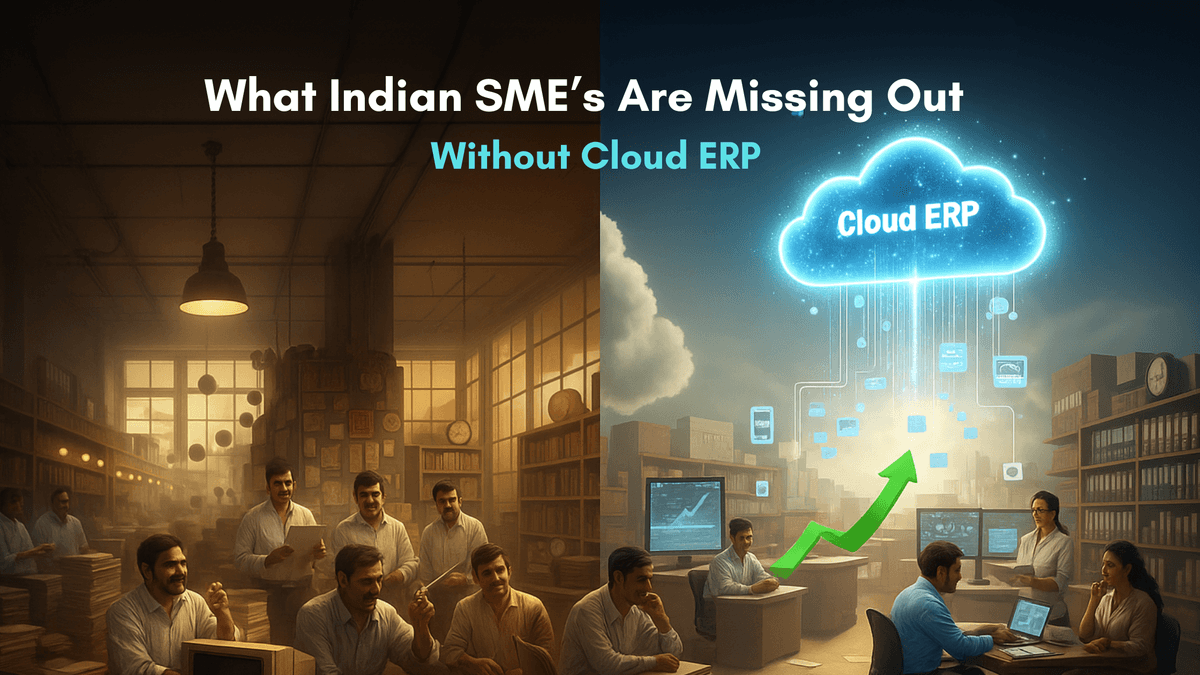
India’s small and medium enterprises (SMEs) are a key engine of growth for the economy. However, many still manage core operations using isolated spreadsheets, paper invoices and local software on their computers. This matters, because without cloud ERP, you lose visibility into your cash and make costly compliance mistakes while your business misses out on growth opportunities.
How big is the SME story in India?
SMEs are central to India’s economy. The sector’s gross value added is roughly 30% of national GDP, and the formal estimate of MSME units stands at about 633.88 lakh (63.4 million), providing more than 110 million jobs, according to government data.
Why the right software matters
An ERP links finance, inventory, sales and reporting in one place. In the cloud, even a small team can access real-time accounts, bank feeds and GST reports from anywhere. Vendor and analyst pieces report faster closes, fewer reconciliation errors, and time savings when firms adopt cloud ERP tools.
The adoption gap: growing interest, uneven uptake
Digital adoption is rising — one study found over 73% of MSMEs reporting business growth after adopting digital tools like UPI and smartphones. Many MSMEs also plan to increase cloud budgets. Yet full ERP adoption across the sector remains uneven: interest is high, but many businesses remain on partial or manual systems.
What Indian SMEs actually lose without cloud ERP

- Cash surprises and late receivables: In most of the cases manual invoicing and reconciliation make cash forecasting unreliable; whereas ERP implementations show faster month-end closes and clearer cash visibility.
- Compliance friction: GST and payroll rules need accurate books. Cloud ERP platforms automate tax calculations and produce returns faster, reducing audit risk and overhead.
- Growth ceiling: manual processes break when order volumes rise — leading to stockouts, missed deadlines and lost customers. Indian case studies show clear efficiency gains after moving finance and inventory to cloud platforms.
Why cloud — not on-premise — is the practical choice today
Cloud ERP converts large upfront capital costs into predictable monthly payments, avoids heavy local IT teams, and delivers upgrades and security patches from the provider. Market research shows the India ERP market expanding quickly, with cloud taking a growing share of new implementations — making cloud the pragmatic route for resource-constrained SMEs.
The real blockers — not all technical
SME hesitation is rarely about features alone. Cost perception, limited digital fluency, fears about data safety, and connectivity gaps are common. Academic reviews and industry reports repeatedly identify awareness, skills and perceived vendor lock-in as major barriers — but each has practical remedies (pilots, phased rollouts, local partners).
Affordable, low-risk paths forward
Start small: implement a single module such as accounting or inventory to get a quick win; entry cloud plans in India can begin at a few hundred rupees per user per month.
Choose Indian-proof implementations: select vendors or partners who demonstrate GST, payroll and banking integrations and show local case studies (Zoho, Tally cloud partners, Ramco, Microsoft Business Central among others). Ask for live demos using your data.
Real ROI — not vaporware
SME projects that pick realistic scope, get basic training and measure outcomes produce rapid returns. Case studies from Indian customers report 20–30% improvements in accounting and order-to-cash cycles after cloud adoption — gains that can repay subscriptions within months.
A note on security and vendor choice Security is a legitimate concern. Large cloud providers invest heavily in controls, but misconfiguration and weak access management create risk. Industry security research recommends strong identity controls, granular permissions, regular backups, and vetted implementation partners to reduce exposure
Convince the board in one page (a practical checklist)

- Quantify time lost to manual tasks (hours × salary).
- Request an India-specific demo that shows GST and bank integration; ask for a 90-day pilot.
- Budget for short training and insist on SLAs for uptime and backups.
Measure month-end close time, invoicing cycle and reconciliation errors at 30/60/90 days.
Conclusion
India’s SMEs have the talent and the opportunity to scale — but many are leaving money on the table because daily operations are held together by spreadsheets and manual effort.
Cloud ERP is not magic, but when chosen and rolled out sensibly it becomes the operational backbone that protects cash, simplifies compliance and unlocks growth. With rising cloud budgets, proven case studies and affordable entry options, the real decision for a business owner isn’t whether cloud ERP helps — it’s how soon they can stop losing to manual errors.